


Rotten Wood Under Your Roof: Why Solid Decking Is Non-Negotiable Before a New Roof Goes On
When most homeowners think about replacing their roof, they think about shingles. Color, style, manufacturer, warranty. Those things matter. But underneath every layer of shingles and underlayment is a surface that rarely gets talked about until it becomes a serious problem: the roof deck. And if that deck has rotten wood, nothing else about your new roof matters. The installation will fail, your warranty will be voided, and you'll be right back to square one in a fraction of the time a quality roof should last.
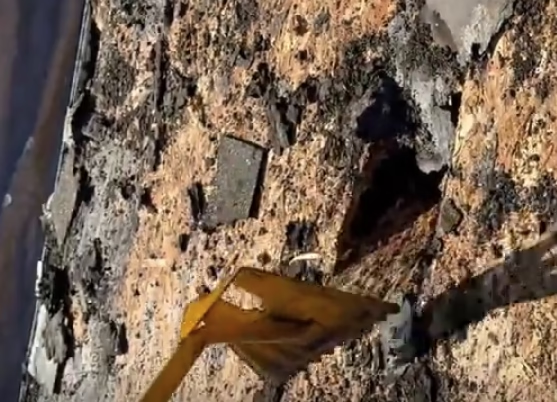
At Level Up Improvement, we see rotten wood on roof decks more often than most homeowners expect. The video attached to this post is a real example from a recent job right here in the metro Detroit area. What you're looking at is rotten OSB, and if you're not sure what that means or why it's a problem, keep reading.
What Is OSB and Why Is It on Your Roof?
OSB stands for oriented strand board. It's an engineered wood product made by compressing and gluing together layers of wood strands in alternating orientations, which gives it strength and stability across the entire panel. OSB has been the standard material for roof decking on residential homes across Michigan and the rest of the country for decades because it's strong, consistent, cost-effective, and takes fasteners well when it's in good condition.
That last part is important: when it's in good condition.
OSB does one thing very well under normal circumstances. It gives your roofing system a solid, continuous surface to attach to. Shingles are nailed through underlayment and into that deck. Flashing is secured to it. The ice and water shield that Michigan code requires bonds to it. The entire roof system above it depends on that deck being firm, flat, and capable of holding a nail without giving way.
When OSB gets wet and stays wet, it breaks down. The wood strands begin to separate. The panel swells, delaminates, and softens. What was once a rock-solid structural surface becomes something closer to wet cardboard. You can press your thumb into it. Nails pull right through. And once a panel reaches that point, it cannot do its job, period.
What Causes Rotten Wood on a Roof Deck?
The most common cause is exactly what it sounds like: a leak that went unaddressed long enough to saturate the OSB repeatedly over time.
In the video attached to this post, the damage you're seeing was caused by a leak. Water found its way past the roof covering, whether through failed flashing, cracked shingles, a compromised valley, or another entry point, and it soaked into the OSB below. Over time, that repeated moisture exposure broke down the panel completely. By the time we got to it during tear-off, the wood was black, soft, and completely unusable as a roofing substrate.
Other causes of rotten wood on roof decks include poor attic ventilation (which allows humidity to build up and condense on the underside of the deck), ice dams that force water back under shingles during Michigan winters, and improper original installation that left gaps where water could travel.
The problem with all of these scenarios is that they're invisible until you pull the old shingles off. Homeowners don't see it. Sometimes even inspectors miss it. That's why working with a roofing contractor who actually looks at the deck during tear-off, and tells you the truth about what they find, matters as much as any other part of the job.
What Michigan Building Code Requires
This isn't just a best practice. It's the law.
The Michigan Residential Code, which is based on the International Residential Code (IRC), is very clear on this. Under Section R905.2.1, asphalt shingles must be fastened to a solidly sheathed deck. The code requires that roof decking be a solid, nailable surface. It cannot be delaminated. It cannot have excessive nail holes from prior installations that compromise the panel's ability to hold a fastener. It must be structurally sound.
The MRC also specifies that roof deck sheathing must be a minimum of 5/8-inch plywood or OSB for asphalt shingle applications. That thickness requirement exists for a reason: it ensures the panel has enough material to grip a roofing nail properly and hold it under load, including the wind uplift and snow load that Michigan roofs deal with every single year.
When rotten wood is present and a contractor installs new shingles over it anyway, they are violating the Michigan Residential Code. Full stop. Beyond the code violation, they are also putting the homeowner at serious risk: a new roof installed over a compromised deck will not perform the way it should, the shingles will not be properly secured, and the manufacturer's warranty will be void the moment nails are driven into a surface that can't hold them.
Any roofing contractor who skips over rotten wood to save time or avoid a difficult conversation with the homeowner is not doing their job.
Why a Solid Nailable Surface Is Everything
Think about what a roofing nail is actually doing. It's driven through a shingle, through layers of underlayment, and into the deck below. The holding power of that nail is what keeps your shingles attached to your home during a 60 mph wind event. It's what keeps your roof from peeling back during a Michigan thunderstorm in July or a winter wind event coming off Lake Erie.
If that nail is going into soft, rotten wood, it has no real holding power. It might as well be driven into foam. The shingle appears attached, but it isn't. Not in any meaningful way. And when weather tests it, the results can be catastrophic.
Beyond wind resistance, a solid deck is critical for the structural integrity of the entire roof system. The deck is what ties your rafters or trusses together as a unified surface. It distributes weight, including snow loads that can reach 20 to 40 pounds per square foot in Oakland County and southeast Michigan during heavy winters. A compromised deck doesn't distribute that load. It deflects, sags, or in severe cases, fails entirely.
This is why we never skip damaged decking. When we find rotten wood during a tear-off, we stop, we show the homeowner exactly what we found, and we replace it before a single piece of underlayment goes down. It's the only way to do the job right.
What Deck Replacement Looks Like in Practice
When we identify rotten OSB during a roof replacement, the process is straightforward. We remove the damaged panels and document what we found and what we replaced. We cut back to the nearest rafter or truss to ensure the new panel has proper support on all edges. We install new APA-rated OSB or plywood at the correct thickness, nail it per code, and then continue with the installation as planned.
In many cases, the cost of replacing a few sheets of damaged decking is a fraction of the overall project cost. It is never worth skipping. The alternative, putting a new roof over rotten wood, is not a roof replacement. It's a ticking clock.
If your roof is showing signs of a leak, or if you haven't had it inspected in several years, it's worth having someone get up there and take a look before a small problem turns into a deck replacement across half your home.
Level Up Improvement: Honest Roofing for Oakland County Homeowners
We're based in Royal Oak at 4425 Fernlee, and we serve homeowners throughout Oakland County and metro Detroit. When we replace a roof, we do it the right way, which means checking the deck, replacing what needs to be replaced, and never putting new materials over a surface that can't support them.
If you've got a leak, if you're overdue for a replacement, or if you just want to know what's actually going on up there, give us a call. We'll give you a straight answer.
@level_up_improvement If I can push a roofing shovel straight through your roof deck, you have a serious problem. In this video, Ivan barely applies pressure and the OSB gives way. It is soft, saturated, and completely rotted from long term leaks. From the ground, this roof did not look catastrophic. But underneath the shingles, moisture has been sitting in the decking, breaking it down layer by layer. Once OSB absorbs water repeatedly, it loses its structural strength fast. That means compromised support for your shingles, sagging areas, and the potential for much more expensive repairs when it is time for a replacement. Roof leaks rarely fix themselves. They quietly spread until the damage becomes obvious and costly. If you are in Southeast Michigan and have stains on ceilings, soft spots on the roof, or an older system that has not been inspected, now is the time. We perform detailed roof and attic inspections to catch structural damage before it gets worse. Get in touch with us here https://levelupimprovement.com/contact/ or send us a message to schedule yours. RoofInspection RoofLeak HomeMaintenance MichiganHomes RoofReplacement SoutheastMichigan
♬ original sound - Level Up Improvement - Level Up Improvement
Level Up Improvement | Royal Oak, MI 48073 | 4425 Fernlee | Serving Oakland County and Metro Detroit