


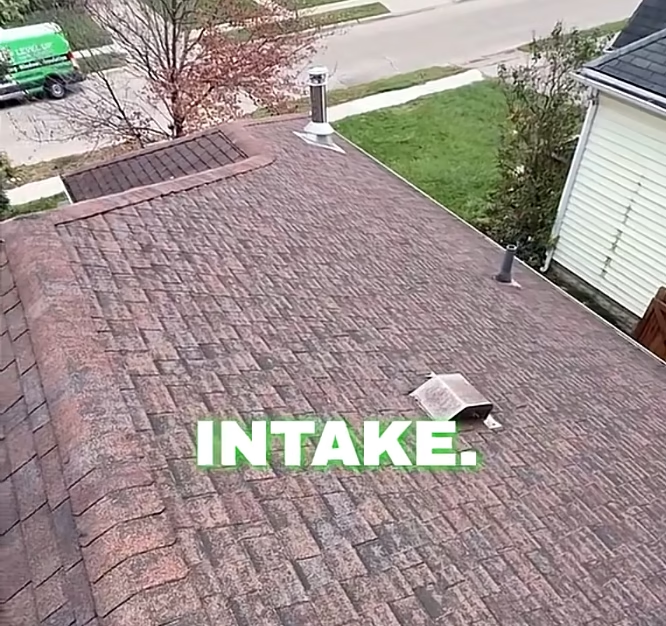
Poor attic ventilation signs aren’t always obvious from the ground. Sometimes, the first thing a homeowner notices is discoloration, dark streaks, or shingles that appear to be aging unevenly.
During a recent roof inspection, we came across a great example of why ventilation deserves more attention.
The roof had noticeable dark streaking across several sections of asphalt shingles. From the outside, it was easy to see that something deserved a closer look.
Our video highlights the importance of attic airflow and why roofing contractors need to evaluate more than just the shingles.
At Level Up Improvement, we inspect roofing systems throughout Southeast Michigan. One thing we regularly explain to homeowners is that a roof needs more than good shingles to perform properly.
It also needs an effective ventilation system.
What Does Poor Attic Ventilation Look Like?
There isn’t one universal sign of poor attic ventilation.
Some homeowners notice problems inside the attic. Others see changes in their roof’s appearance.
Common warning signs include:
- Excessive heat inside the attic during summer
- Moisture accumulation or condensation on roof decking
- Mold or mildew growth on attic surfaces
- Rusted roofing nails or metal components
- Uneven snow melting during winter
- Ice dams along roof edges
- Premature deterioration of roofing materials
Dark streaks and discoloration can also prompt an inspection, although they don’t necessarily indicate a ventilation problem.
The important thing is identifying the actual cause before recommending repairs or replacement.
Why Are There Dark Streaks on My Roof?
This is one of the most common questions homeowners ask about aging asphalt shingles.
Dark streaks often come from algae growth, particularly a type of blue-green algae that creates dark staining.
Michigan’s humidity, tree coverage, and seasonal weather can contribute to these conditions.
However, moisture-related issues can also affect roofing materials.
In our video, you can see dark streaking across multiple areas of the roof. The footage also shows existing roof vents.
The appearance raises an important question: Is the roof getting the airflow it needs?
You can’t answer that question by looking at the shingles alone.
A proper inspection should evaluate the attic, intake ventilation, exhaust ventilation, insulation, and roof decking.
The takeaway: Dark streaks don’t automatically mean your roof has poor ventilation. They do give homeowners a reason to investigate the roof’s condition.
How Does Attic Ventilation Actually Work?
A properly designed attic ventilation system allows outdoor air to enter through lower intake vents and exit through higher exhaust vents.
For many Michigan homes, that means soffit vents near the eaves and ridge vents near the peak.
Here’s how the system works.
Intake Ventilation: Where Fresh Air Enters
Intake ventilation typically comes from vents beneath the roof overhangs.
These soffit vents allow outside air to enter the attic.
But there’s something homeowners often overlook.
Just because a house has vented soffit panels doesn’t mean air can actually get through them.
We’ve encountered homes where contractors installed vented soffit material without creating adequate openings behind it.
From the outside, everything looked normal.
Inside the attic, however, the ventilation system couldn’t function as intended.
Insulation can also block intake openings when installers fail to maintain clear ventilation paths.
That’s why checking the actual airflow openings matters.
Exhaust Ventilation: Where Air Leaves
Exhaust vents allow attic air to escape through openings near the upper portion of the roof.
Common exhaust options include ridge vents, roof box vents, and other properly designed ventilation systems.
The type of vent matters, but the overall system matters more.
Adding exhaust ventilation without adequate intake doesn’t necessarily improve airflow.
In some cases, poorly planned vent combinations can create unintended airflow patterns.
A roofing contractor should evaluate the entire system before adding or changing vents.
Why More Roof Vents Don’t Always Mean Better Ventilation
This is one of the biggest misconceptions we encounter.
Homeowners see several roof vents and assume their attic must have plenty of ventilation.
Unfortunately, that’s not always true.
A roof can have multiple exhaust vents but very little functional intake ventilation.
Imagine trying to drink through a straw while covering the other end.
The problem isn’t necessarily the straw. It’s the lack of an open path for air.
Attic ventilation works on a similar principle.
Without adequate intake, exhaust vents may not deliver the airflow the system needs.
That’s why we pay attention to both sides of the equation.
Can You Have Too Much Exhaust Ventilation?
Yes, a poorly balanced ventilation system can create problems.
For example, adding multiple exhaust vents without enough intake can interfere with the intended airflow pattern.
Combining different exhaust systems may also cause one vent to pull air through another.
The solution isn’t automatically adding more vents.
Instead, a contractor should calculate the required ventilation area and follow the applicable building code and manufacturer instructions.
Can Poor Attic Ventilation Damage Roof Shingles?
Poor attic ventilation can contribute to conditions that shorten the useful life of a roofing system.
During hot Michigan summers, excessive attic temperatures can increase heat exposure beneath the roof.
In winter, warm, moisture-laden air entering the attic can create condensation problems when it contacts cold surfaces.
Over time, moisture accumulation may damage roof decking and other materials.
Ventilation alone doesn’t control every attic moisture problem, though.
Air leaks from the living space, inadequate insulation, and improper exhaust ducting can also contribute.
Bathroom fans and dryer vents, for example, should never discharge directly into an attic.
A good inspection considers all these factors.
For additional information, the U.S. Department of Energy explains the importance of insulation and air sealing in residential buildings.
Why Attic Ventilation Matters So Much in Southeast Michigan
Michigan’s changing seasons put roofing systems through a lot.
During summer, the attic can experience significant heat buildup.
Winter brings freezing temperatures, snow, and the potential for ice dams.
Spring and fall introduce temperature swings and changing moisture conditions.
That makes proper attic design particularly important for homes throughout Oakland and Wayne counties.
We see a wide range of roof designs in communities like Royal Oak, Birmingham, Bloomfield Hills, Troy, Ferndale, Clawson, Novi, and Dearborn.
Older homes may have ventilation systems that no longer meet current needs.
Others have undergone siding, insulation, or roofing renovations that changed the available airflow.
Every house is different.
That’s why we don’t believe in recommending the same ventilation solution for every roof.
Can Poor Attic Ventilation Cause Ice Dams?
It can contribute to them.
Ice dams develop when snow melts on a warmer portion of the roof and refreezes near colder roof edges.
As ice builds up, it can prevent melting snow from draining normally.
Water may then work its way beneath roofing materials.
However, attic ventilation is only part of the solution.
Air sealing and insulation play major roles in limiting heat loss from the living space into the attic.
The goal is to reduce unwanted heat transfer and maintain appropriate roof temperatures.
A contractor who recommends more vents without evaluating insulation and air leakage may overlook the real problem.
What Should a Roofing Contractor Check During an Inspection?
A proper roof inspection should involve more than walking around the house and looking at shingles.
Depending on access and conditions, we recommend evaluating several important areas.
1. The Roof’s Exterior Condition
Check for damaged shingles, excessive wear, staining, deteriorated flashing, and other visible concerns.
2. Intake Ventilation
Confirm that soffit vents have functional openings and that insulation doesn’t block airflow.
3. Exhaust Ventilation
Identify the existing exhaust vents and evaluate whether the system provides appropriate airflow.
4. Roof Decking
Look for moisture damage, staining, deterioration, and other signs of possible attic problems.
5. Insulation and Air Sealing
Evaluate whether insulation and air leakage could contribute to excessive attic heat or moisture.
6. Ventilation Balance
Review the available net free ventilation area and compare it with applicable requirements.
A good window or roofing contractor should be able to explain what they found without overwhelming the homeowner.
More importantly, the contractor should explain why a particular repair or improvement makes sense.
Frequently Asked Questions About Attic Ventilation
How do I know if my attic has enough ventilation?
A roofing professional can evaluate your attic’s intake and exhaust ventilation.
The inspection should include the size and location of vents, available airflow paths, and signs of moisture problems.
Simply counting roof vents isn’t enough.
Will adding a ridge vent fix poor attic ventilation?
Not necessarily.
A ridge vent can provide effective exhaust ventilation when the roof design supports it.
However, the system still needs adequate intake ventilation.
Adding a ridge vent without addressing blocked soffits may leave the original problem unresolved.
Can blocked soffit vents damage a roof?
Blocked soffit vents can restrict attic airflow and contribute to heat or moisture problems.
The severity depends on the roof design, insulation, air leakage, and other conditions.
A contractor should identify and correct the blockage rather than assume the roof needs replacement.
Do dark streaks mean my shingles are failing?
No.
Dark streaks often result from algae growth and don’t necessarily indicate shingle failure.
However, unusual discoloration deserves a closer look, especially when other symptoms appear.
A roof inspection can help distinguish cosmetic staining from material deterioration.
Should attic ventilation be checked before replacing a roof?
Absolutely.
Roof replacement provides an opportunity to evaluate the existing ventilation system.
Contractors should review intake and exhaust ventilation before choosing the final roof design.
That helps avoid installing new shingles over an unresolved ventilation problem.
Why We Check More Than Just the Shingles
At Level Up Improvement, we believe a roof replacement should address the entire roofing system.
That includes shingles, flashing, underlayment, roof decking, and ventilation.
We’ve seen firsthand how problems beneath the surface can affect a roofing project.
For example, during a Bloomfield Hills roof replacement, our team encountered unexpected roofing conditions that required additional attention.
Situations like that reinforce why thorough inspections matter.
We also believe homeowners deserve honest recommendations.
Sometimes a roof needs replacement. Other times, the right solution involves improving ventilation, correcting insulation problems, or addressing a specific repair.
Our job is to explain the difference.
As a family-owned exterior remodeling company, we don’t believe in high-pressure sales tactics.
We’d rather help homeowners understand what’s happening with their roof and make the right decision for their home.
Watch Our Video: Why Poor Attic Ventilation Matters
In our latest video, we take a closer look at a roof with visible dark streaking and discuss why attic ventilation deserves attention.
The footage shows how much you can learn by examining a roof beyond its surface appearance.
It’s also a reminder that existing roof vents don’t automatically guarantee adequate airflow.
Watch the video here:
Concerned About Your Roof’s Ventilation?
If you’re noticing roof discoloration, moisture problems, ice dams, or unusual shingle deterioration, it may be time for an inspection.
Level Up Improvement helps homeowners throughout Southeast Michigan understand their roofing systems and make informed decisions.
We serve Royal Oak, Birmingham, Bloomfield Hills, Troy, Ferndale, Clawson, Waterford, Novi, Plymouth, Northville, Dearborn, and surrounding Metro Detroit communities.
For more homeowner education, check out our DIY window screen replacement guide or learn more about Level Up Improvement.
Have questions about your roof?
Call (313) 287-9525 or visit levelupimprovement.com to request an inspection or estimate.
No high-pressure sales pitch. Just honest advice and quality work.
Do it right!